Check your J-Curve
As published by CEOWORLD Magazine – Rick Andrade
It’s the answer to the question CEOs and business leaders everywhere are asking:
Where’s my AI ROI?
It’s been four years this November when ChatGPT (2022) released its first Large Language Model igniting a tech tidal wave of new investment in Artificial Intelligence not seen since the roll-out of fiber cable lines to accommodate the fledgling Internet 26 years ago.
In fact, the adoption story and promised evolutionary business case have seduced nearly every senior executive across every industry.
The original claim was that AI, now Agentic AI would replace vast hordes of real human jobs from accountants to zoologists. But the AI ROI isn’t showing up on the financial statements, and companies still need the same workers. What’s going on?
Investors are getting nervous. I warned about this ROI thing back in February in my CEOWorld article It’s 2026, Can Your AI Spell RIO?
Seven months later investors still need a magnifying glass to find material AI cost savings. And they’re asking point blank…What’s the problem?
According to Goldman Sachs Research, global AI-related investment is forecast to exceed $1 trillion in 2026, including about $581 billion in the US. That implies AI capex of roughly 1.8% of US GDP in 2026, rising to 2.5% in 2027 and 2.8% in 2028.
Most of the spend is driven by large “hyperscalers,” such as Amazon Web Services, Microsoft Azure, Google Cloud, Meta, and Alibaba Cloud all building out data centers to quench the unquenchable thirst for “token compute.”
Smaller private companies, meanwhile, are themselves expected to spend $35 billion on AI investment this year and if “tokens” are the new AI currency:
“We blew through our AI budget in a quarter, for the whole year,” said Dara Khosrowshahi, CEO of Uber in June 2026. In a recent interview on CNBC, Alex Karp, CEO of data analytics software company Palantir said his customer CEOs are livid, “they’re paying [millions] for tokens that create no value.”
And they’re not alone.
CEOs everywhere are begging for some relief. Because it’s ‘show me the money’ time from AI investors, or else.
This is when it starts to feel like dumping buckets of cash down an AI black hole and waiting for something good to happen.
Of course, unalarmed by the growing spending binge, tech professionals point to a familiar friend to explain it.
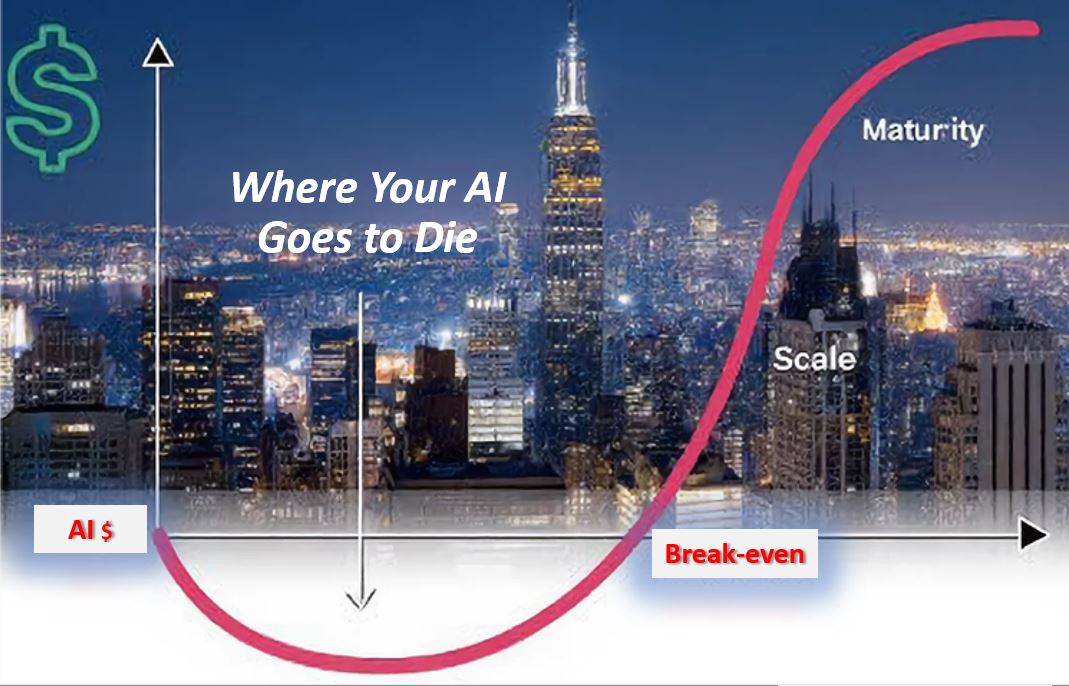
They call it the J-Curve.
And if you’re reading this your company is likely among millions stuck in the belly of it, and sweating your own leadership tenure.
As you know, the J-curve describes a pattern in which results initially worsen due to the massive upfront investment before leveling off and rising upward, forming a J shaped curve.
But after 4 years of constant AI spend, most companies have yet to turn that AI ROI corner enterprise-wide. And unless you can dig your way out soon, proving you’re on the right side of the curve, you’re likely to die there, begging the question:
Can I dig my way out before it’s too late?
“The key is to use the right token for the right use case.” Antonio Neri, HPE CEO, CNBC Sep 3
And that is indeed one way to save big money. But that’s not going to dig you out.
What we now know is that AI is NOT going to kill off jobs by the millions as expected, at least not yet. Some functions do see staff reductions like finance, marketing and customer service. Those are low hanging fruit.
But widespread staff cuts aren’t happening. Instead, roles are changing. AI is shifting the focus of knowledge workers from task performance to multi-task agentic AI management. And there’s no going back.
I’ve seen advanced Agentic-AI systems build new websites in a single prompt, set up entirely new product development processes and supply chain efficiencies in minutes. Which is what CEOs want to see. But will that increase ROI?
The pros say we’re jumping the gun. They say we need to focus on “conversion” as the precursor to financial ROI.
Conversion is the act of recognizing AI efficiency gains (time saved) and then channeling those gains toward a distinct measurable financial outcome.
This means more sales, but also adding the ability to measure the intangible values like higher quality products, customer service ratings and faster throughput workflows.
In other words, it’s not that your AI ROI has vanished into the abyss, rather it’s about converting localized task improvement speeds into firm-level financial performance your investors will reward you for.
That makes sitting in the trough highly actionable, and not simply a money-pit agony CEOs must endure. It is where you must decide whether AI becomes a costly targeted function token expense or a new operating model refresh, aka the Promised Land of AI.
McKinsey’s 2026 survey finds 80% of respondents report personal productivity gains from AI, but only 37% see any EBIT impact, and just 6% qualify as AI high performers.
Here’s a quick assessment test. Ask yourself yes or no:
- Is AI making our measured workflow faster or better?
- Is the saved capacity visible at the team or business-unit level?
- Has leadership deliberately redeployed that capacity?
- Has the firm tied the redeployment to a financial or operating metric?
- Have downstream constraints, approvals, data access, policies, compliance, handoffs, customer demand been redesigned?
If the answer is ‘yes’ to the first question only, Yikes! You’re in the muck.
Time to right-size the ship.
1. Diagnose why your company is stuck
Research shows us that most companies see AI as automating tasks, not transforming the business. And there’s a stuck-in-a-hole documented reason for that. According insiders including a recent McKinsey analysis: The State of AI in 2026: On the Road to ROI, you’re underwater if —
- Your AI is measured by token usage. The executive dashboard celebrates tokens purchased, active users, prompts, or model usage, rather than customer outcomes or financial performance.
- Your teams save time but don’t redeploy that value. People finish work faster, but no leader has decided how that capacity should create additional sales coverage, product releases, innovation, customer service, or cost removal.
- Your AI speeds up one step but not the full workflow cycle. A proposal takes 20 minutes to draft but still takes two weeks to review. A support agent answers faster but still waits on a technical escalation. A sales team creates more outreach but has the same lead-qualification bottleneck.
- Your operating model remains unchanged. Roles, decision rights, incentives, performance measures, and approval rules were designed for pre-AI work.
- Your Pilots are everywhere and accountability is nowhere. Innovation teams run proofs of concept, but business-unit leaders do not own a baseline, a benefit target, or a date for “Conversion.”
2. Determine your high-level value-capture metrics
Before approving an AI use case, require the sponsoring executive to state how the firm will capture value from it: For example:
- More throughput: more proposals, product/services sold, customer conversations
- Higher quality: fewer defects, errors, returns, escalations, or compliance failures
- Faster cycle times: shorter quote-to-cash, design-to-launch, close, service, approval cycles
- Lower cost-to-serve: fewer hours per unit or service sold, less rework, less headcount
- Revenue growth: more customers, repeats, retentions, cross-selling, dynamic pricing, and new offerings
3. Use Agentic AI solutions to redesign and remap workflows
This is where Agentic AI shines brightly. Automating tasks that once took hours now can take only minutes. Once you’ve mapped your old workflows from the triggering event (order) to the post sale customer satisfaction (delivery) score, you can identify each new time-sucking task and remove it.
If your AI produces a pricing recommendation in five minutes but it still takes two weeks for final review, the productivity constraint (bottleneck) has simply shifted, not disappeared.
In MBA school we had to read The Goal (pub.1984). The key to profit is eliminating constraints aka bottlenecks at each step along the workflow process. Done right, your AI will identify these bottlenecks for you.
The point is to take executive action and redesign your approval process, and only introduce a human into the mix when key data security and quality control checks require it.
4. Explicitly measure and redeploy saved capacity
Here’s the real ROI. This is how you pivot from the bottom of the curve on upward.
Many CEOs wait, expecting AI investment to miraculously turn additional productivity capacity into revenue generating growth or cost savings. But now that we realize job cuts alone are NOT going to pay for AI investments you have to redeploy that accumulated time efficiency in its place.
For each team using pricey frontier models, ask them to adopt one primary, lower‑cost, pre‑approved open‑source model for in‑house work. Then ask them to target one or more value-creating destination targets to measure. Hold them accountable to it, ask each specific unit/division team lead to track and report the following:
- More Sales: more prospects closed, more customer meetings, more sales coverage, more product demos, more backlog.
- More Service: shorter response times, more proactive outreach, improved first-contact resolution, fewer escalations.
- Better Quality and Risk Management: faster testing, better controls, fewer errors, stronger compliance, tighter security protocols.
- Less Cost: fewer task hours, more throughput per worker, less operating expenses.
- More Innovation: more new product development, added features, competitive functionalities, automation ideas, customer utility capabilities.
Not that every hour saved must immediately translate into higher productivity or sales, however, no major efficiency gain (from token expense) should remain ownerless and unaccountable to the P&L.
That’s my key takeaway.
The J-curve is not a promise that every AI investment will automatically pay off. It is an explanation for why AI-ROI can be delayed when a company adopts a general-purpose technology without a plan.
The role of the CEO is therefore the key linchpin to AI success, to actively manage workflow redesigns, workforce transitions, and to roll-out strategies that guide AI investments from the bottom of the pit to sustainable, revenue-producing new highs.
Remember, the bottom of the AI J-curve is not where companies’ AI fails because models are too expensive or hallucinate or jeopardize data security. It’s where companies fail because management treats a general-purpose technology as a plugin-play task helper, instead of an enterprise-wide agentic game changer.
Firms that turn up the curve do three things differently: they redesign the workflow, redeploy earned capacity, and hold business unit leaders accountable for measurable value-creating outcomes.
Boom! Drop the AI mic.